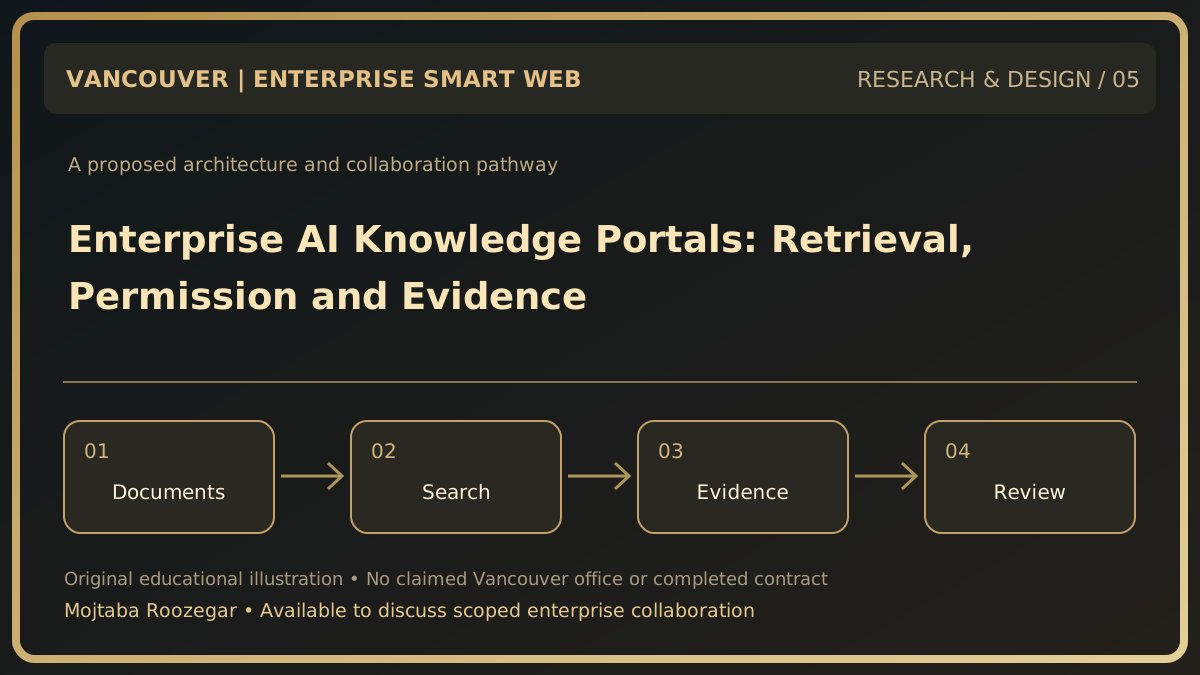
Why a large enterprise needs more than a chatbot
I am open to discussing AI-assisted knowledge websites with Vancouver commercial and industrial organizations. Employees may need policies, equipment manuals, contract procedures or technical guidance drawn from many systems. A convincing conversational interface is not proof that answers are reliable. An enterprise tool must control document permissions, indicate provenance, handle conflicting versions and make uncertainty visible. The right goal is faster evidence-backed work, not unqualified promises that artificial intelligence can replace domain experts.
Build a governed retrieval pipeline
Ingestion should record document ownership, classification, revision, effective date, access scope and a reproducible source identifier. Apply access checks before retrieved passages reach a language model; filtering only the final response is insufficient. Segment documents carefully so technical constraints and surrounding context are not lost. Retrieval indexes need deletion and update procedures to prevent withdrawn instructions from remaining available indefinitely. Record citations at passage level whenever feasible.
Evaluate answer quality systematically
Develop benchmark questions reviewed by knowledgeable staff, including cases with no answer, conflicting documents and expired procedures. Score factual support, citation precision, permission correctness and refusal to invent missing facts. A model can perform well on simple questions and fail badly on rare but critical tasks; use category-level results instead of a single marketing percentage. Add a human escalation route and version evaluation results when model or source changes occur.
Protect confidential operations
Separate public marketing content from private internal knowledge. Enforce least-privilege roles, redact secrets from logs and choose storage according to the enterprise's data-governance requirements. Avoid feeding confidential contracts or personal information to external services without authorization. A retrieval-augmented system can still be vulnerable to malicious instructions embedded inside documents; treat retrieved content as untrusted evidence rather than operational commands.
A credible first pilot
I would propose an evaluation using a small approved document collection with synthetic records and a predefined question set. Deliver an interface, citation trace, access-control tests and an error taxonomy. Only after stakeholders inspect performance should a larger data connection or deployment be considered.
Collaboration note: Mojtaba Roozegar is open to discussing a scoped Vancouver enterprise project. This educational proposal does not represent a confirmed Canadian office, commercial client, legal work authorization or deployed solution.