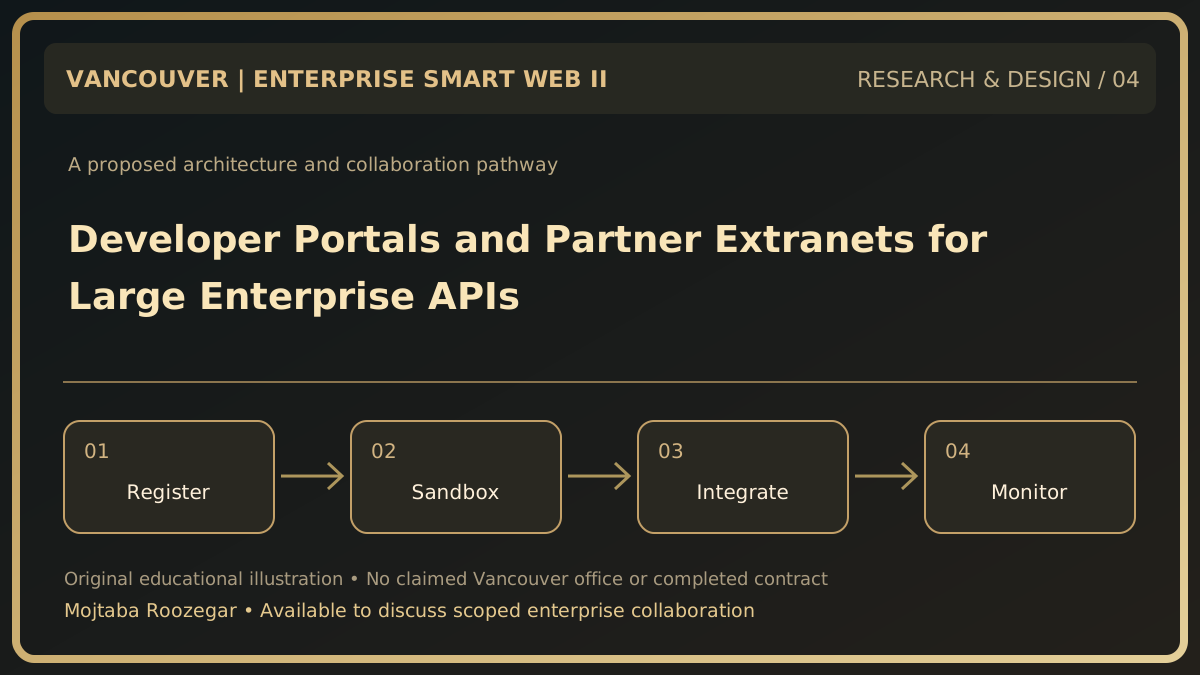
Enterprise partnerships need operational integration
I am ready to explore building developer and partner websites for Vancouver commercial organizations. A modern API ecosystem requires more than a Swagger page. Authorized integrators need a dependable description of available operations, onboarding conditions, identity, quotas, environments and lifecycle changes. Business units need visibility into who has been granted access and what obligations apply. A partner extranet can become a product in its own right when workflows are governed and measurable.
Treat an API as an externally consumed contract
Document operations using a maintained specification such as OpenAPI where it fits, alongside response examples and failure semantics. Distinguish sandbox behavior from production behavior. Explain idempotency, pagination, rate limits, supported versions and the handling of partial failures. A generated schema can still be inaccurate if the deployed service differs from its description. Contract tests should verify representative endpoint responses and reject unauthorized access to organization-specific resources.
Secure the integration onboarding journey
A developer account may request sandbox access without receiving production credentials. Production enablement may require commercial approval, risk assessment and data processing terms. Keys must be shown and stored safely, rotated with a clear procedure and revoked promptly. Avoid sending secrets through ordinary email or embedding them in a browser bundle. Use narrow scopes and explicit partner identity, rather than one shared master key for all integrations.
Operate the ecosystem transparently
Provide test status, changelogs, incident notices and migration guidance. API analytics should measure usage, errors and latency without leaking customers' private payloads. When a breaking change becomes necessary, instrument existing adoption and give partners an achievable migration path. An accessible troubleshooting experience can reduce support effort. Clearly label whether a response came from a simulator or a live service and maintain boundaries between partner accounts.
A proposed Vancouver pilot
A bounded demonstration could include partner registration, approval-gated sandbox credentials, a documented sample API and three negative-access tests. Stakeholders would review the operational experience before any customer data or production credentials are connected. I welcome discussions with Vancouver enterprise platform and integration leaders.
Editorial note: Prepared by Mojtaba Roozegar as a proposed Vancouver enterprise collaboration.