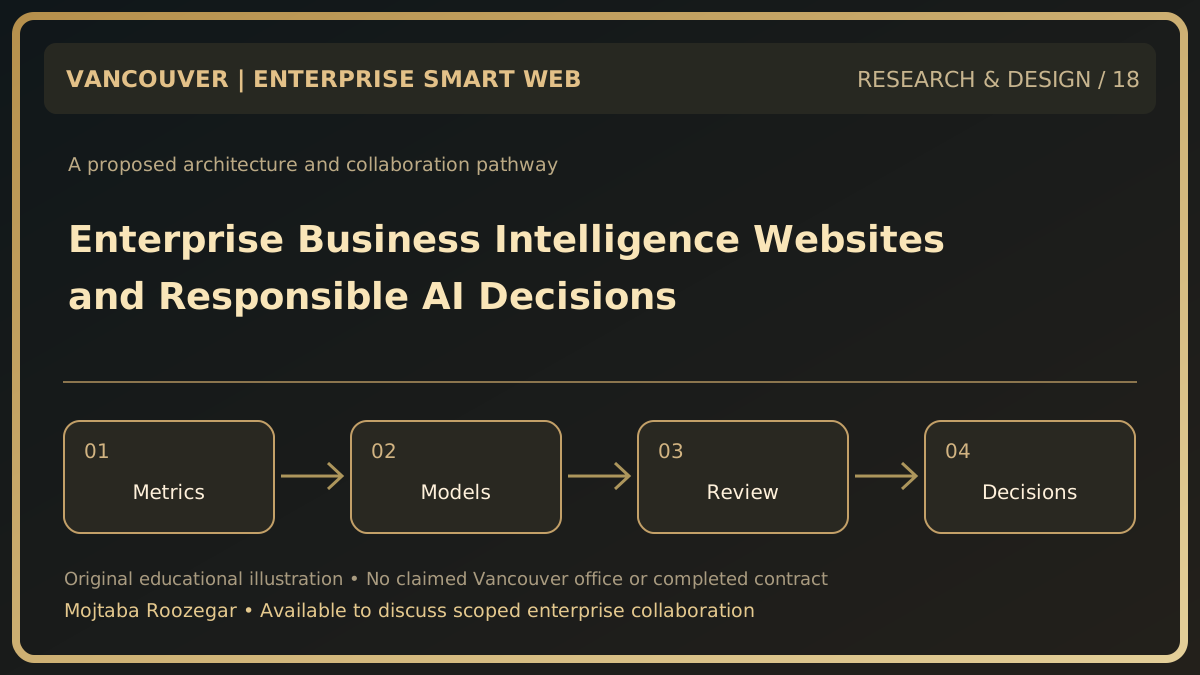
Start with a management decision
An enterprise intelligence portal has value when it helps authorized users make a better decision, not when it merely displays more charts. I am open to working with Vancouver commercial and industrial teams on browser tools for production economics, inventory planning, customer service or financial monitoring. The first step is to identify a decision owner, action options and the quality of evidence currently available.
Define metrics rigorously
Every displayed measure needs a unit, time window, source and calculation rule. Revenue, margin, gross profit and cash flow are distinct concepts. Inventory turnover needs an agreed denominator; an apparent improvement may be caused by missing records. Record data freshness and distinguish verified actuals from estimates. When the underlying source is incomplete, the website should display a warning or confidence range rather than silently substituting invented values.
Introduce AI only with evaluation
An AI-assisted forecast or textual summary should be tested against a baseline and reviewed for unsupported claims. Track evaluation datasets, model versions, systematic errors and drift over time. A predictive result should disclose assumptions and not be represented as a guarantee. Management decisions involving finance, workforce or operational safety require authorized human review. AI-generated text is especially risky when it confidently invents an explanation for a change in the underlying data.
Connect dashboards to corrective workflows
A useful tool can let a manager open the underlying transaction list, assign a review, document a decision and verify the resulting change. Permission checks should cover both aggregates and records. Charts require accessible summaries, and drilldowns should remain performant at enterprise scale. Keep a versioned record of data transformations so an unexpected KPI shift can be diagnosed rather than debated solely from screenshots.
Pilot offer
A bounded project might combine three predefined metrics, a synthetic dataset, an exception-review workflow and an optional source-grounded AI summary. Evaluation should test calculations, access rules and unsupported statements. I welcome discussions with Vancouver enterprise analysts and software teams about developing such responsible decision-support systems.
Editorial note: Original educational proposal by Mojtaba Roozegar.