Modernization is not automatically a rewrite
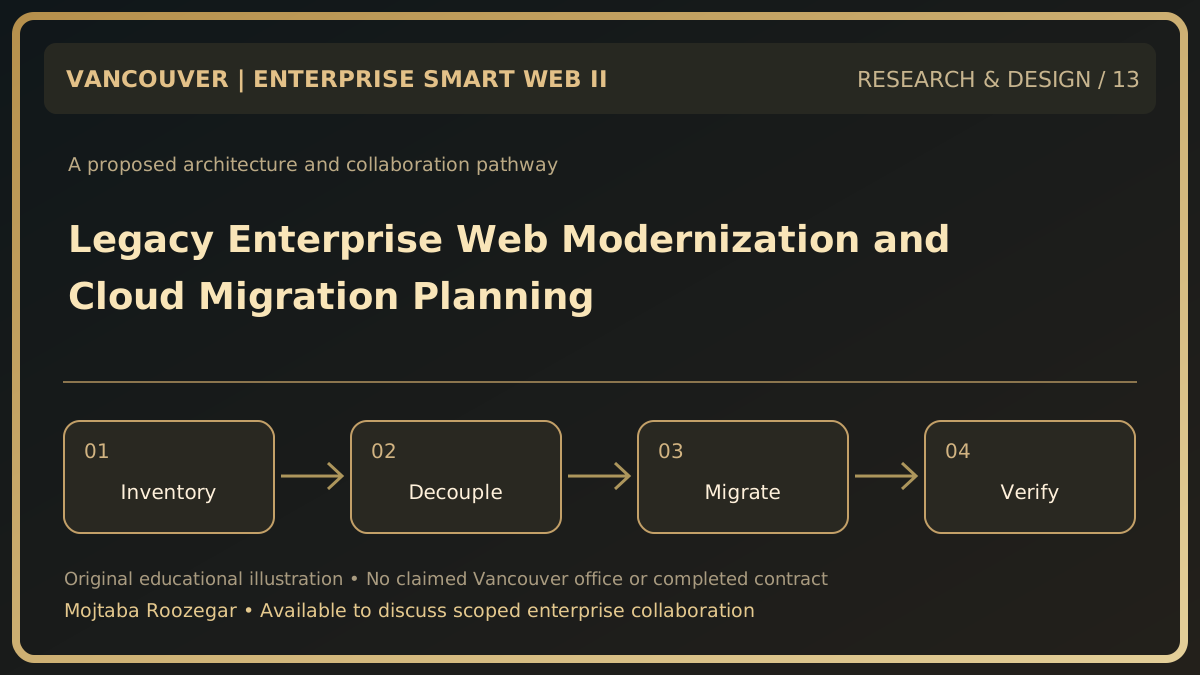
I am interested in collaborating with large Vancouver companies that need safer modernization of older web applications. A legacy system may contain years of business rules and operational knowledge that are not written elsewhere. Replacing the interface without identifying those rules can disrupt production or billing. The first objective is a verified inventory of routes, dependencies, data stores, user roles and peak workflows. Any recommendation should compare preserving, refactoring, replacing and retiring components.
Map hidden coupling and data contracts
Create a dependency graph for database tables, scheduled jobs, shared file paths and external integrations. Observe actual use where authorized and identify which features remain business critical. A single database often supports multiple modules that appear independent in a diagram. Before separating them, define authoritative data ownership and compatibility needs. Export scripts and background workers are particularly easy to overlook. Preserve transaction behavior and historical data requirements during proposed changes.
Plan migration by reversible increments
Where practical, use a strangler approach: route one bounded workflow through a new implementation while the remaining system stays available. Maintain a clear coexistence strategy for identity and data. Schema changes should be backward compatible until all consumers are updated. A change that deletes a shared column may prevent rollback even if code files are restored. Test representative data volume and define a safe pause or cutover procedure for writes that cannot occur simultaneously.
Verify real user and operator outcomes
Modern infrastructure can be more expensive and harder to operate if designed without workload evidence. Measure p95 latency, failure rate, maintenance effort and recovery objective before and after the pilot. Test deep links, authorization, integrations, static files, mobile layouts and operational runbooks. Retain an independently verified backup and rehearse restoring it. Public claims of zero downtime should be avoided unless monitoring demonstrates that outcome for the actual change.
Proposal for a Vancouver partner
A first engagement could audit one fictionalized subsystem, produce architecture decision records and migrate a low-risk workflow with measured acceptance tests. I welcome discussion with enterprise IT and consulting groups about modernization pathways, with commercial and security responsibilities agreed before any production access.