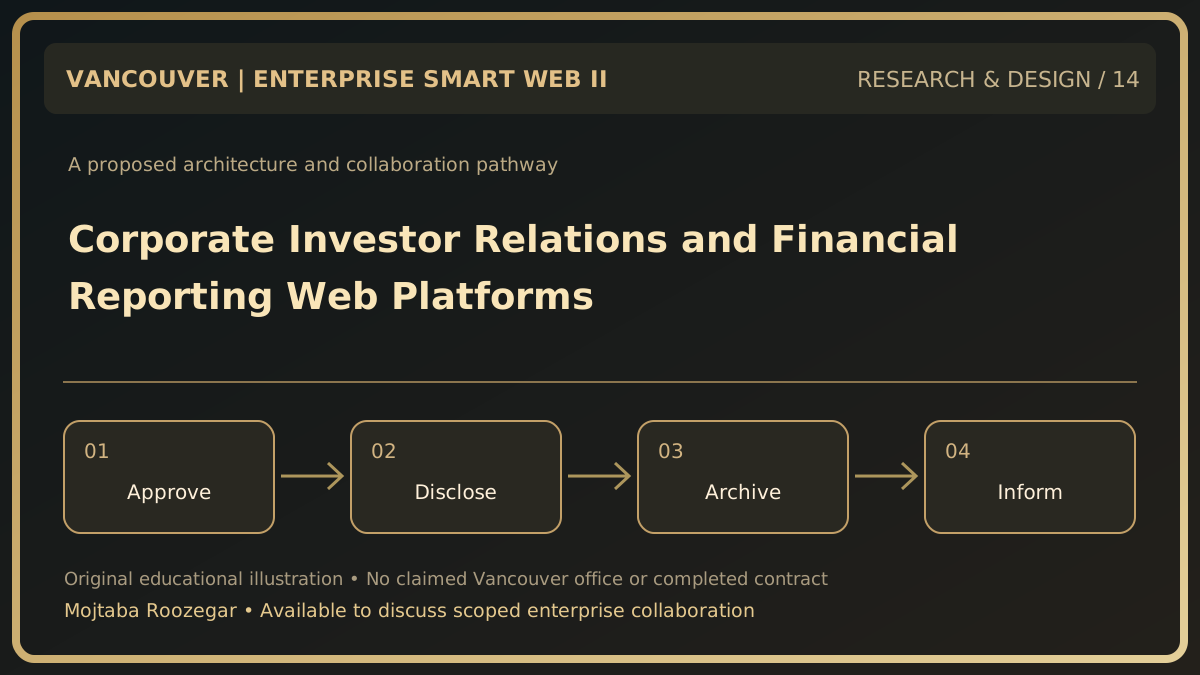
Corporate reporting requires disciplined publishing
I am available to discuss sophisticated corporate websites with Vancouver businesses that communicate with owners, investors or other stakeholders. Such work is different from a marketing blog: a financial disclosure may require precise approval, release timing, document retention and consistency across languages. A digital platform must not invent investor relations status or imply that a private company is publicly listed. Legal, securities and disclosure obligations depend on the actual organization and require qualified oversight.
Separate draft review from public release
Financial publications can pass through authored, reviewed, approved, scheduled, released, corrected and archived states. Each transition needs appropriate authority. A document being uploaded is not proof that its figures have been verified. Maintain the exact approved file, version checksum, published timestamp and an explanation of corrections. When a report is superseded, retain the relevant historical reference rather than silently replacing it. Publishing tools should make unauthorized early disclosure difficult.
Present figures without losing meaning
Financial tables should preserve accounting labels, currency, period, units and comparative basis. A quarter-over-quarter change should not be inferred from incompatible reporting periods. Interactive charts can help but must have accessible table equivalents and clear sources. Automated executive summaries need strict controls against invented figures. The source of truth should remain the reviewed report, with user-facing derived metrics calculated consistently and validated before release.
Serve distinct audiences carefully
Public corporate information and private board materials require separate access policies, caching and search visibility. A portal can provide subscriptions, document downloads and meeting materials without exposing confidential shareholder information. Notifications should be triggered by genuinely approved events. Keep audit logs for changes and incident response, while avoiding private data in ordinary analytics. Localization should be reviewed for material legal and financial terminology, not performed blindly.
Possible collaboration
A safe pilot could stage an invented annual-report workflow, require two approvals, produce an accessible public release and test correction handling. The organization would determine any securities or corporate-law requirements before production.