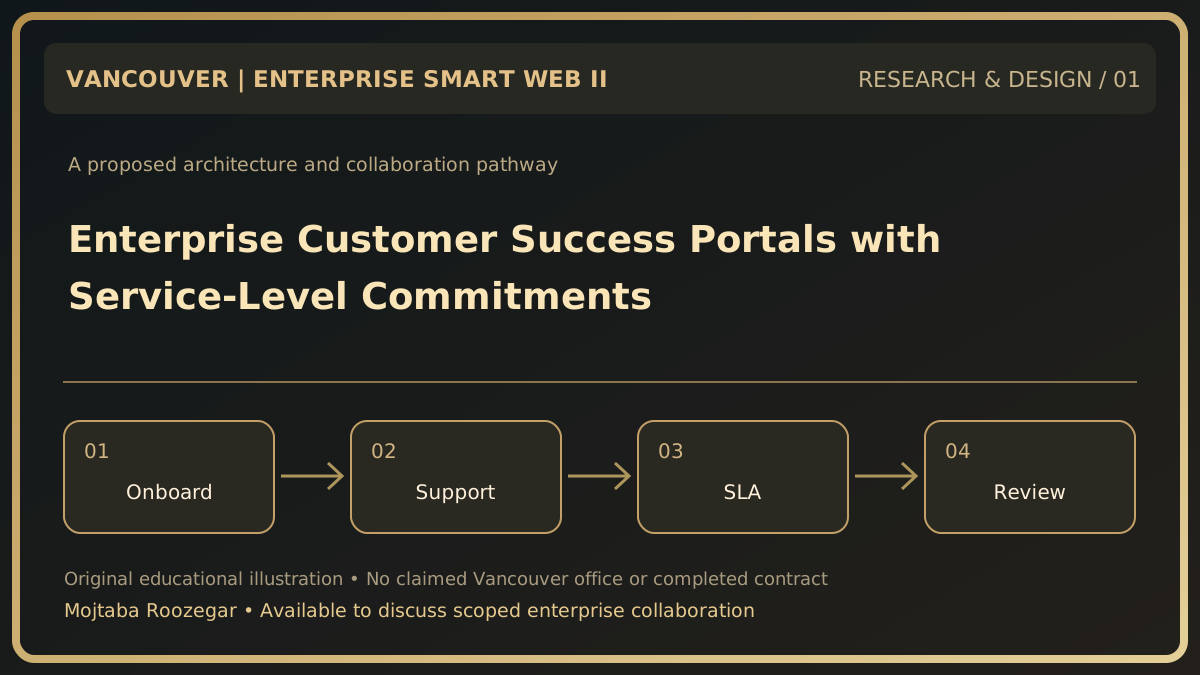
Why this is different from a standard corporate website
I am available to explore sophisticated customer success platforms with large Vancouver businesses. A customer portal should not merely replicate a contact form. An enterprise client may have several subsidiaries, negotiated support plans, entitled users, service assets and different response commitments. These relationships need a clear domain model. The proposed website would make authorized services and unresolved responsibilities visible.
Model commercial entitlements and onboarding
Begin with organizations, accounts, customer locations, installed products, service contracts and named contacts. A newly invited employee should receive only the resources their organization and role permit. Distinguish onboarding checklist completion from actual equipment commissioning. A contract may cover specific hours, issue severities and regions; those conditions must be versioned so historical tickets keep their original terms. Define what happens when a contract expires while an existing case remains open. Avoid silently using current terms for past obligations.
Compute service-level measurements carefully
A first-response clock, active resolution clock and customer-waiting interval should be separate values. Holidays, contractual time zones and paused states require explicit calculation rules. If a provider publishes a response target, the application should not falsely report success after a manual ticket closure. Recalculate metrics from auditable event timestamps and keep correction history. Make at-risk work understandable to support staff without exposing privileged contract information to unrelated customers. A dashboard should explain exceptions, not hide them.
Connect support work to actual improvements
The portal could include issue intake, attachment screening, priority classification, knowledge suggestions, a controlled escalation path and customer approval of closure. AI-assisted summaries may help agents, but authoritative decisions belong to designated staff and must be sourced. Track repeated faults by asset or service while respecting retention policies. Report actionable indicators such as reopened cases and aging segments, rather than treating a large number of closed tickets as proof of success.
Suggested engagement and verification
I would propose a fictional multi-company support pilot with two distinct service contracts, role-scoped ticket viewing and deliberately delayed escalations. We would test timezone boundaries, duplicate notifications, revocation and SLA computation against hand-verified examples. A Vancouver enterprise or customer-experience integrator could then decide whether the approach fits existing service platforms. This article is an invitation to discuss possibilities, not a representation of a completed deployment.
Editorial note: Prepared by Mojtaba Roozegar as a proposed Vancouver enterprise collaboration.