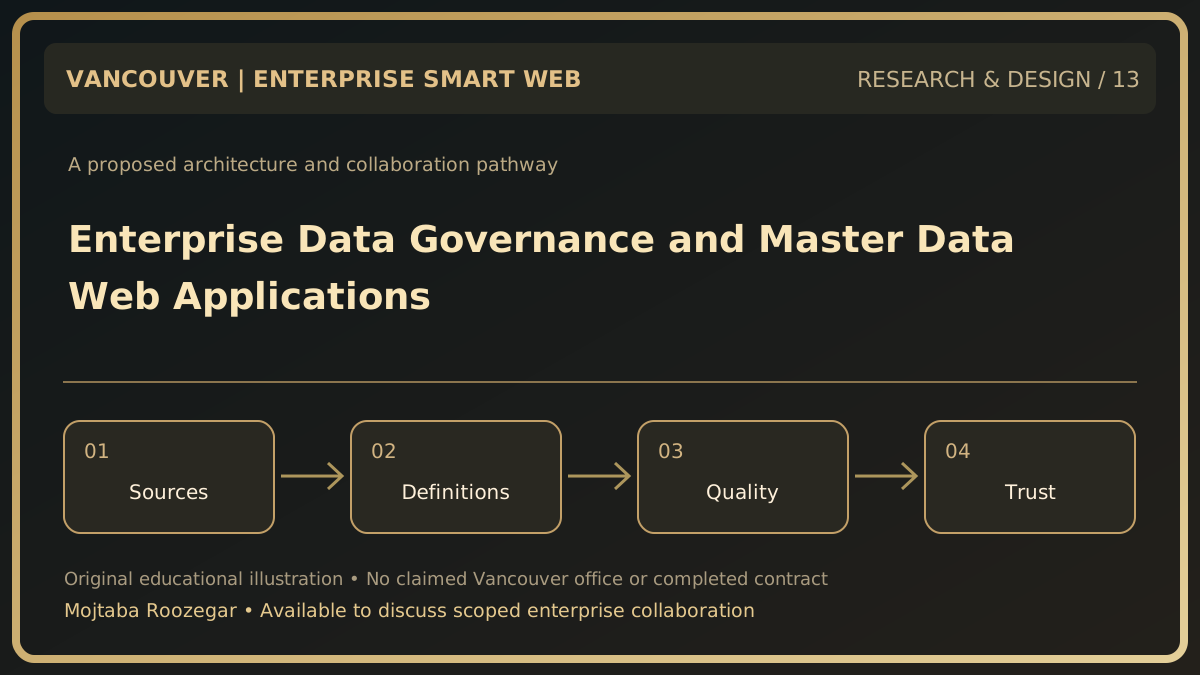
Governance is a product capability
Large industrial and commercial organizations may have separate definitions of customer, supplier, facility, product and transaction. I am open to collaborating with Vancouver enterprise teams on web applications that make those definitions visible, reviewable and enforceable. The goal is not to purchase a dashboard and assume data quality has been fixed. A useful portal gives data owners the ability to diagnose discrepancies and approve controlled changes.
Start with definitions and stewardship
Document authoritative identifiers, system owners, business meaning, units and permitted values. Maintain a glossary for metrics such as gross margin, completed order and active customer. A metric is untrustworthy when two departments use incompatible denominators. Every critical dataset should have an owner who can approve changes and explain how users should interpret it. A website can present stewardship workflows but cannot replace organizational accountability.
Trace data from collection to report
Lineage records should show which source fields and transformations contributed to a displayed number. When source data changes, record effective dates and communicate which reports need recalculation. Quality checks might evaluate completeness, timeliness, consistency and allowed ranges. Automation should flag likely issues but allow documented review; silently deleting anomalous entries may remove real evidence. An AI summary must cite the approved source rather than generating untraceable explanations.
Protect classification and access
Not all users should see raw identity, commercial or employee data. Build dataset-level and row-level policies as appropriate, plus audit trails for sensitive changes. Data minimization may be more useful than building elaborate interfaces that expose unnecessary details. Evaluate privacy and retention obligations under the particular partner's activities and jurisdictions. Public pages should never reveal administrative data lineage details that could become a security risk.
Proposed collaboration
A small pilot might define a supplier master record, ingest two synthetic sources, identify deliberate conflicts and route correction through a steward approval workflow. Success evidence would include traceable corrections, reproducible validation results and role isolation. I would welcome a discussion with Vancouver commercial groups about this scope, subject to approved access and professional agreements.
Author: Mojtaba Roozegar. Scope, lawful operating arrangements and commercial terms would be agreed with a prospective Vancouver organization; case descriptions are illustrative.