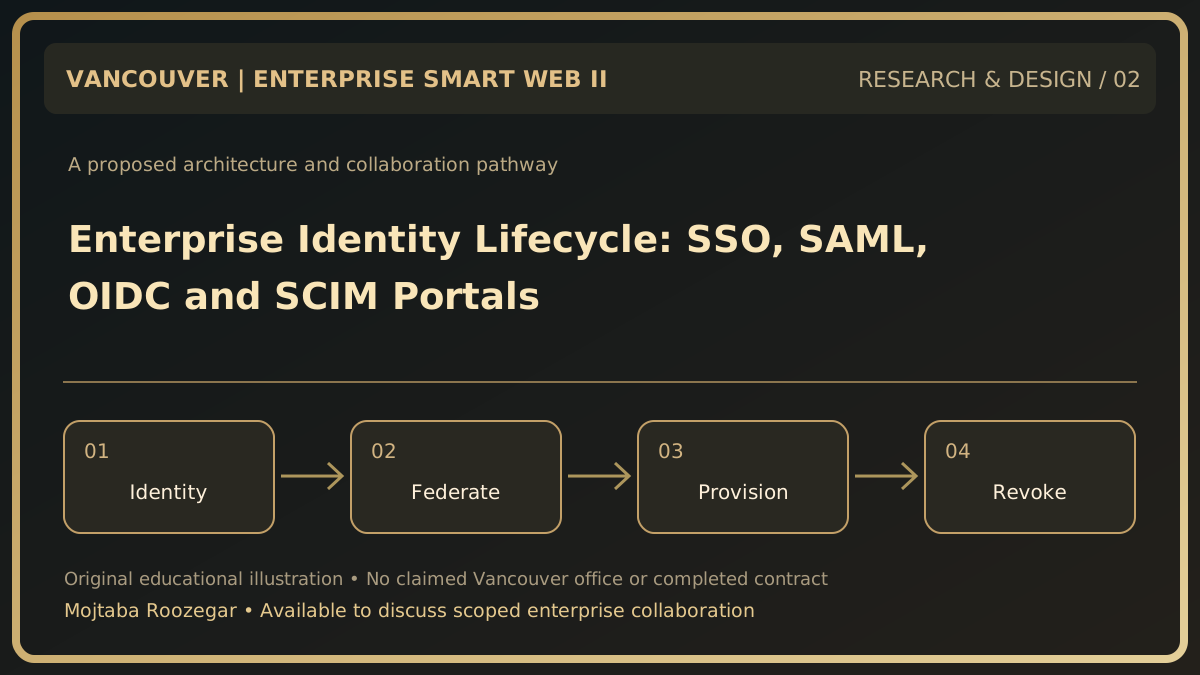
An identity problem beyond login screens
I am interested in working with Vancouver enterprise identity and web teams on dependable account lifecycle integration. Corporate websites often need to coordinate employee identity providers, vendor identities and application-specific entitlements. Single sign-on is not simply a button that allows a company login. The application must distinguish authentication, user provisioning, tenant membership, access review and removal of rights when a relationship ends. Mistakes can expose sensitive customer or operations data even when passwords are handled correctly.
Choose standards for concrete relationships
OpenID Connect builds authentication around identity tokens and OAuth-based flows; SAML can support enterprise identity federation in organizations that already rely on it. SCIM provides a standardized way to provision and deprovision user identities and groups. The partner's current infrastructure and security requirements decide whether these standards are needed. Never accept unsigned identity assertions or presume that an email domain proves enterprise membership. Map stable external identifiers explicitly and handle renamed users without creating duplicate privileged accounts.
Treat account lifecycle as state transitions
An identity may be invited, active, suspended, disabled or removed from a specific business tenant. Provisioning requests can arrive late or be retried. A request to remove access should have a measurable completion outcome and a review trail. A user who retains a browser session after suspension must not keep accessing protected objects. Group-to-role mappings should be approved and versioned; otherwise an innocent directory configuration change can grant purchasing or administrative permissions to too many people.
Build auditable configuration and recovery
Administration screens should make federation certificate rotation, redirect allowlists, group mappings and failed provisioning events inspectable to approved operators. Secrets and signing keys require disciplined storage and rotation. Separate production federation configuration from a test tenant. Negative tests should cover incorrect audience, expired assertions, clock skew, replayed provisioning requests and cross-organization lookup. Break-glass recovery access must be restricted and audited rather than hidden in undocumented default credentials.
A pilot for a Vancouver organization
A useful first deliverable could federate an isolated test application with one approved identity system, show group-driven authorization and demonstrate automatic removal of rights. Documentation would include identity mappings, failure paths and owner responsibilities. I am ready to discuss such a project with experienced identity specialists; any production federation requires enterprise security approval and an agreed contract.
Editorial note: Prepared by Mojtaba Roozegar as a proposed Vancouver enterprise collaboration.