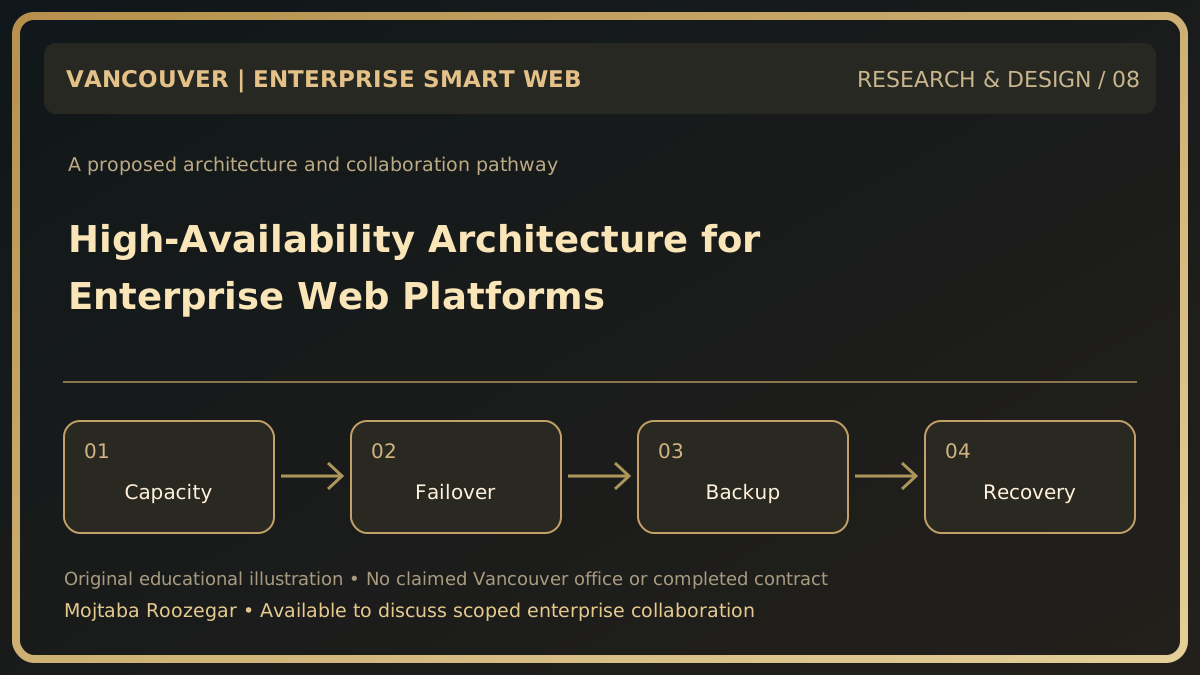
Availability starts with business consequences
I am interested in working with Vancouver commercial and industrial teams that depend on web portals for time-sensitive operations. Different functions carry different risk: a corporate information page may tolerate an interruption that would be unacceptable for an order-confirmation or production-reporting service. Define service level indicators around actual user journeys and agree on target error rates. A stack cannot be called highly available merely because its hosting provider advertises uptime.
Identify single points of failure
Map DNS, certificate renewal, proxy capacity, application workers, database storage, background queues and external identity providers. Consider how users experience a failure at each layer. A second server is not a complete resilience strategy if both instances depend on the same unprotected database or misconfigured load balancer. Build the smallest topology that meets real service and budget requirements, then document dependencies and residual risks.
Design recovery and integrity together
Backups matter only when restoration has been tested against a realistic volume and recovery objective. Define recovery point and recovery time objectives separately; a replica may fail to protect against accidental data deletion. Before changing schemas, ensure the old and new application versions can coexist where needed. Use expand-and-contract migration practices for critical data. For a transactional workflow, test retries and idempotency so a transient timeout does not create duplicated orders.
Instrument failure as a user-visible event
Collect structured logs, metrics and traces with data minimization. Monitor representative deep routes, not only the homepage. A service may return HTTP 200 while displaying stale pricing or a broken checkout. Test actual content markers and transaction-state rules. Alert thresholds should reflect operational impact rather than constant notification noise. An incident procedure needs named responsibilities, technical rollback instructions and a plan for stakeholder communication.
Suggested Vancouver pilot
A practical pilot could simulate a failure of an application worker, a delayed database connection and an unavailable external identity endpoint against a synthetic workload. The deliverable would document observed recovery, limitations and changes needed before production. I welcome collaboration with qualified enterprise operations teams; no service availability guarantee or live customer implementation is claimed in this article.
Author: Mojtaba Roozegar. This is a professional invitation for Vancouver collaboration, with hypothetical design examples rather than verified engagements or business registrations.