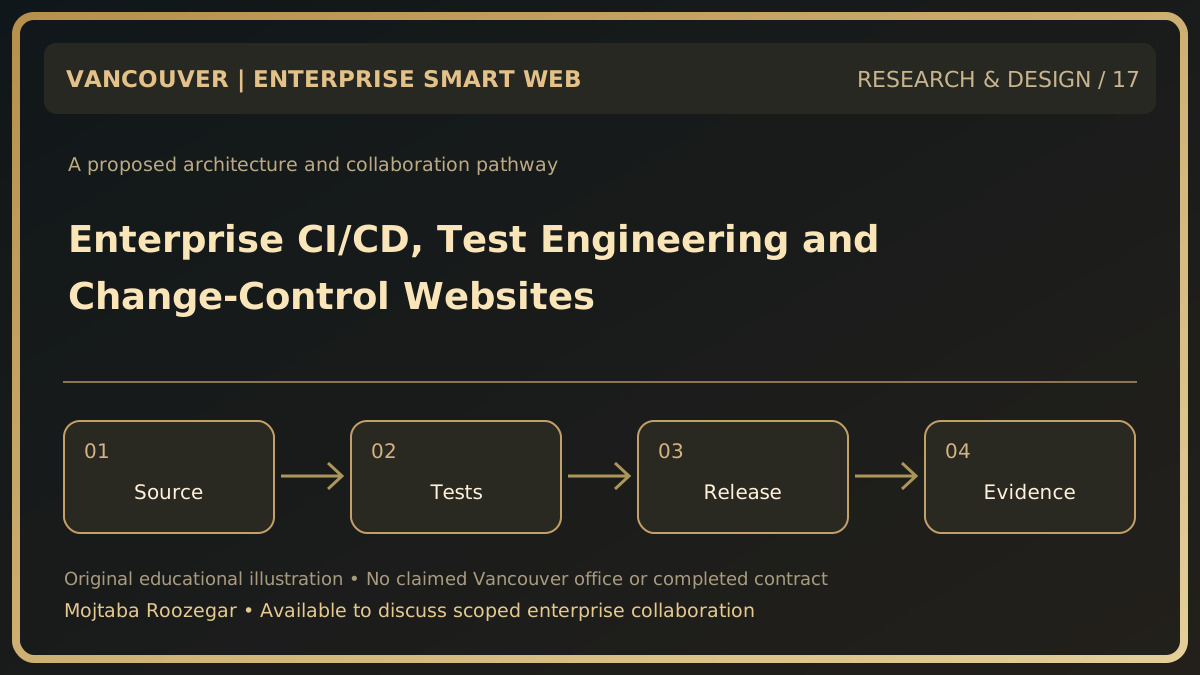
Enterprise delivery needs operational discipline
I am open to collaborating with Vancouver software and enterprise technology teams on release systems for high-value websites. A successful code merge is not proof of a healthy public application. In a commercial or industrial environment, an incorrect deployment can interrupt procurement, reporting or customer transactions. Releases therefore need clearly bounded changes, evidence-backed quality gates and a recovery procedure understood before the deployment begins.
Separate assurance layers
Unit tests protect deterministic rules such as totals and role conditions. Integration tests exercise database constraints, permissions and external API adapters. Browser tests confirm that intended users can complete critical journeys. Contract tests help detect unexpected changes in payloads consumed by other enterprise systems. Security and accessibility checks add further coverage. Test counts alone are not a quality metric; tests should connect to important failure modes.
Design a safe deployment boundary
Record the exact repository commit, artifact identity, target application path, files affected and database migrations involved. Check for unexpected symbolic links or changes to unrelated services. Back up files before replacing them, and handle database modifications with transaction and schema-compatibility plans. Use a release window appropriate to operations and confirm authorization from the owner. A shared hosting environment demands special care to avoid accidentally changing a separate customer website.
Define real post-release evidence
Probe important deep links, not just the home page. Verify authentication, static assets, actual article or product content, representative order behavior and approved administrative functions. Monitor errors and latency during the release. Rollback should restore only records and files owned by that release, with safeguards against erasing changes made afterward. If rollback cannot complete safely, stop and escalate rather than announcing success.
Collaboration proposal
A first engagement could automate tests and a guarded deployment for one noncritical portal module, then rehearse a simulated failure and rollback. Deliver a runbook, permission model and concise evidence log. I am ready to explore such a project with Vancouver enterprise web teams; the example is a possible pilot and not a report of a completed client deployment.
Editorial note: Original educational proposal by Mojtaba Roozegar.