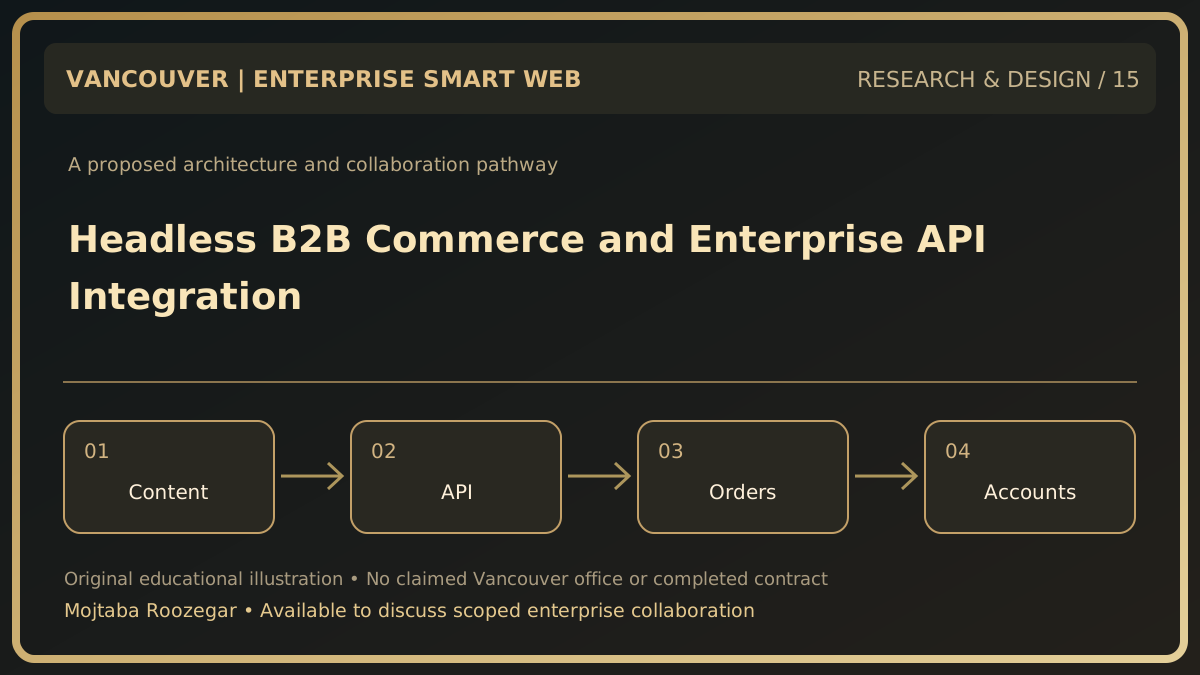
Why separation can matter
I am open to designing modern B2B web platforms with Vancouver enterprise teams where catalog, content, purchasing and fulfillment have different lifecycle needs. A headless architecture can expose these capabilities through stable APIs to a browser, mobile client or business partner. That separation does not automatically improve performance or maintainability. The architecture must account for operational complexity, versioning and access controls that would otherwise be hidden inside one application.
Define API contracts and data ownership
Catalog data, negotiated pricing, identities, entitlements and payment settlement should have clear owners. An order service must not infer authorization merely because a UI has displayed a price. Document validation rules, response versions, error envelopes, idempotency behavior and concurrency boundaries. When multiple systems contribute to a transaction, distinguish committed local state from messages still being processed. Cross-system consistency often requires retryable events and reconciliation rather than a fragile chain of synchronous calls.
Design server rendering for discoverability
Public product and informational pages should expose meaningful HTML to users and search crawlers. Authenticated enterprise pricing and account pages have different caching and indexing needs. A front end may use server rendering, progressive enhancement or a targeted client-side interaction layer depending on the user journey. Hydration costs and large JavaScript bundles should be measured rather than assumed acceptable. Preserve accessible forms and error states when scripts or external services fail.
Maintain a strict trust boundary
Secure administrative APIs, enforce tenant-scoped permissions and keep internal contracts away from public endpoints. Avoid embedding service credentials in browser bundles. A CDN cache must never accidentally share one customer's negotiated pricing with another. Test invalid tokens, cross-account object IDs, timeouts and duplicate order submissions. Choose monitoring that can explain whether a user-visible failure comes from content, commerce, identity or fulfillment.
Invitation for Vancouver collaboration
A small pilot could expose one synthetic catalog and a governed request-for-quotation flow using versioned endpoints, with a minimal accessible storefront and tests. I welcome conversations with enterprise commerce architects and engineering teams about feasibility, integration constraints and appropriate project terms. This article does not assert an existing local commercial deployment.
Author: Mojtaba Roozegar. Scope, lawful operating arrangements and commercial terms would be agreed with a prospective Vancouver organization; case descriptions are illustrative.