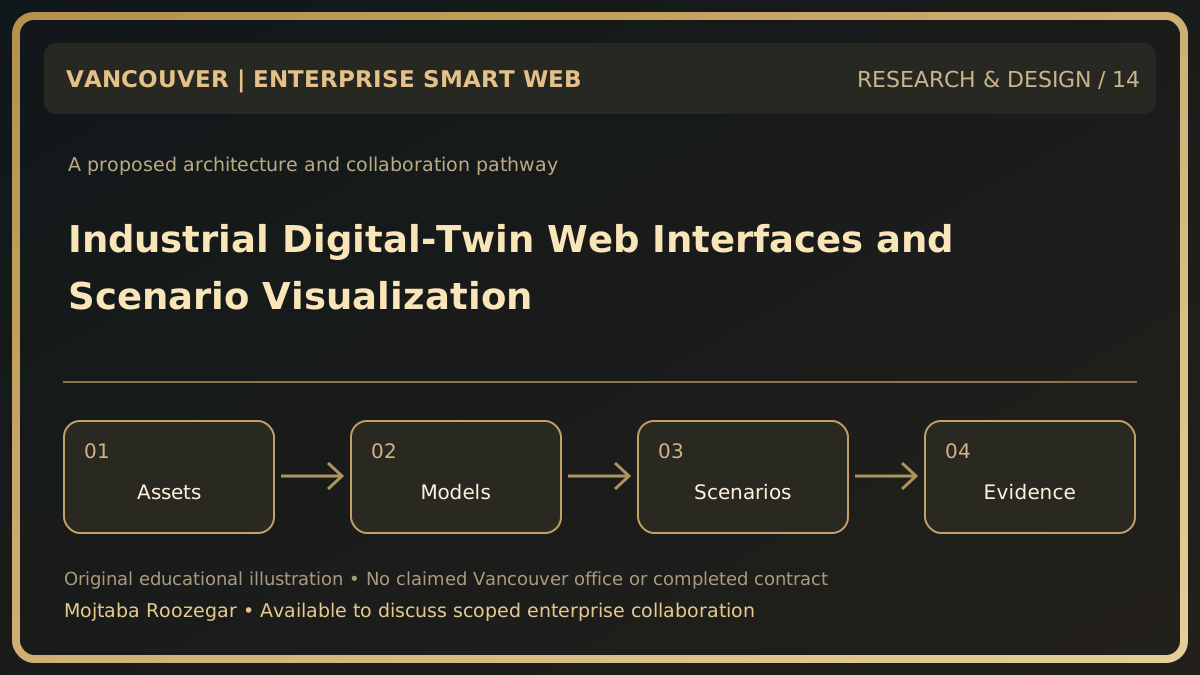
A digital twin requires a definition
I am interested in contributing to web interfaces for industrial digital-twin initiatives with Vancouver engineering and technology partners. The term digital twin is sometimes used for a static three-dimensional scene and sometimes for a continuously updated operational model. These are not equivalent. The proposed collaboration would begin by defining assets, refresh frequency, simulation purpose, decision authority and the evidence needed to interpret results. An attractive rendering alone does not prove predictive capability.
Establish the model boundary
An asset model should map identifiers, equipment structure, measured state and simulated properties. Record which inputs come from live instruments, historical datasets, manual assumptions and calculated estimates. Preserve units and timestamps. Where an OPC UA information model or other enterprise source is used, validate mapping semantics with engineers who own that system. Browser applications should consume approved data services rather than connect directly to sensitive controllers.
Make scenarios reproducible
A scenario engine should retain the initial conditions, selected parameters, model version, execution time and output artifacts. Users must be able to distinguish simulated performance from measured operation. For example, an energy-use projection under different load profiles is not a verified efficiency gain. Show sensitivity ranges and model limitations rather than a single precise-looking forecast. A decision-support tool can help evaluate alternatives without replacing mandatory engineering review.
Design clear interactive visualizations
Provide layer controls, asset selection, accessible annotations and fallback data tables. When three-dimensional views become expensive, progressive loading and performance budgets protect ordinary devices. Avoid using color as the sole indicator of critical alerts. Authorization must prevent a user from querying assets outside their permitted scope. Record scenario sharing and revision to avoid a design review relying on an outdated simulation.
Pilot offer
A safe prototype could model three virtual assets and compare a few clearly invented operating scenarios with source and confidence labels. The deliverable would include test cases for units, scenario reproduction and role-based access. I am ready to discuss such a pilot with Vancouver integrators; no existing industrial digital twin, client contract or engineering certification is claimed.
Author: Mojtaba Roozegar. Scope, lawful operating arrangements and commercial terms would be agreed with a prospective Vancouver organization; case descriptions are illustrative.