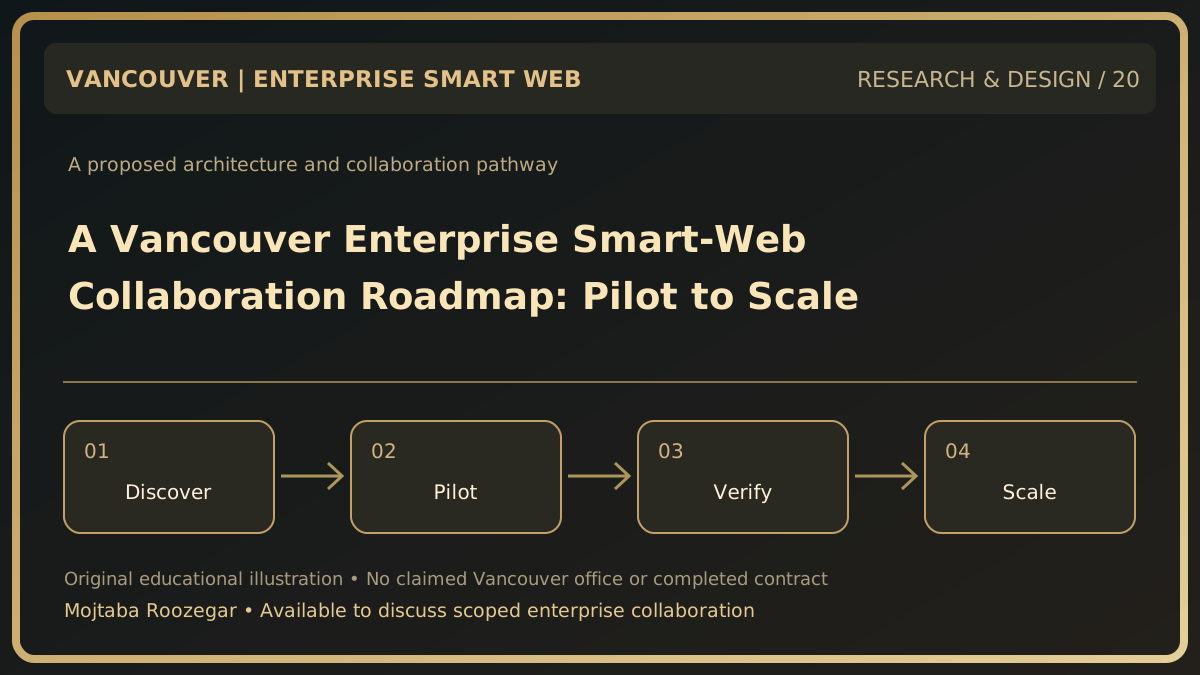
Begin with an honest readiness statement
I am open to exploring professional collaboration with Vancouver-based corporations, industrial operators, commercial groups and established software companies on intelligent website development. My proposed areas include secure enterprise portals, industrial analytics, digital commerce and AI-assisted knowledge applications.
Phase one identifies fit and authority
The first discussion should include a business process owner and a technical counterpart with permission to discuss the intended system. Agree on the problem, users, current software landscape, sensitive data and which operations are out of scope. Write a short discovery record separating verified constraints from assumptions. Determine whether remote collaboration is permissible under relevant company policy and which legal arrangements require professional review.
Phase two establishes a pilot contract
Choose one bounded workflow such as supplier onboarding, asset monitoring or a restricted AI knowledge search. Define synthetic or approved data, working deliverables, milestones and testable acceptance criteria. Clarify the intellectual-property status of existing tools and newly created material. A pilot should have a stopping rule if necessary integrations, credentials or safety approvals are unavailable. It should not depend on modifying unrelated live websites.
Phase three measures operational readiness
Exercise access control, input validation, performance under representative load, accessibility, recovery and incident reporting. Review any industrial interfaces with operational technology owners. Record genuine test evidence and remaining limits. Do not advertise a prototype as production-ready until the client accepts relevant security, integration and reliability requirements. Make pricing and support arrangements transparent before opening the system to real users.
Phase four decides whether to expand
After a successful and documented pilot, compare results with original objectives and agree whether to stop, revise or scale. A larger program may add service-level objectives, release governance, staff training and maintenance ownership. Any public case study needs client approval. I welcome initial conversations with suitable Vancouver teams about this evidence-led approach, while recognizing that actual cooperation depends on mutual agreement and applicable law.
Editorial note: Original educational proposal by Mojtaba Roozegar.