Where collaboration could create value
I am available to discuss web platforms that connect authorized customers, warehouse staff and logistics managers with consistent shipment and stock information. For a Vancouver distribution business, the challenge is not simply drawing a map; it is reconciling purchase orders, inventory reservations, carrier events and delivery exceptions across separate organizations. A successful product helps people make informed decisions while honestly communicating when its data may be incomplete.
Map the lifecycle before the interface
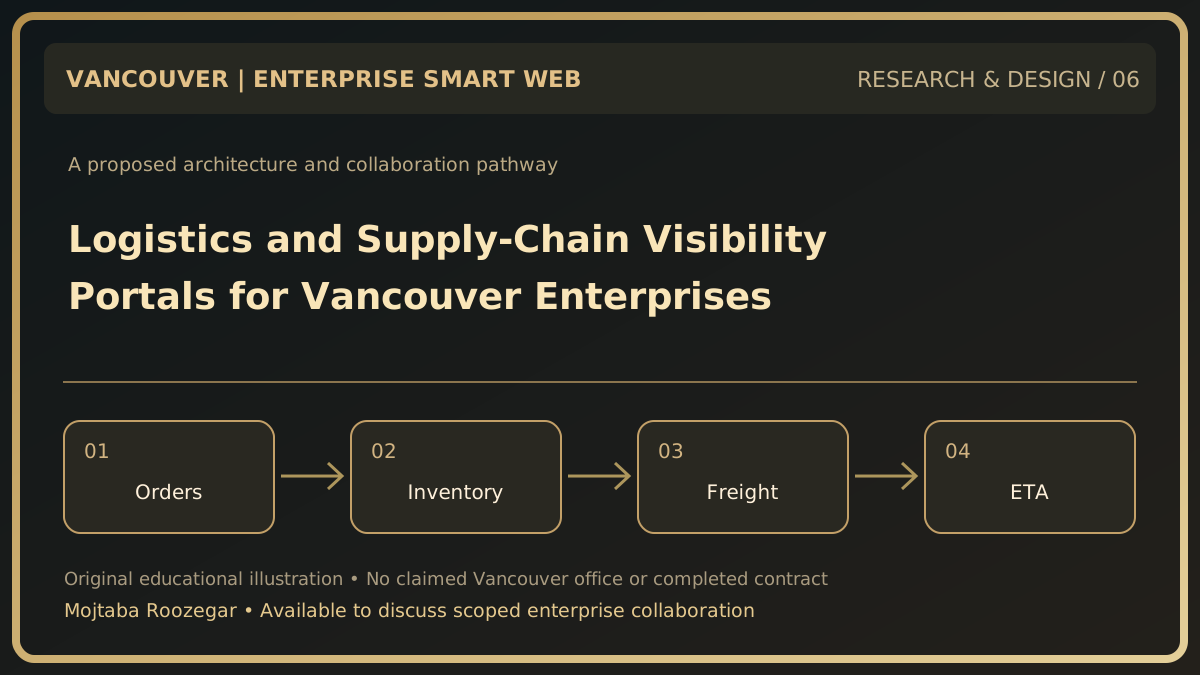
Model a sequence from order acceptance through picking, shipment, handoff, delivery and reconciliation. Define which party owns each state, what evidence confirms a transition and which events can arrive late or out of order. Shipment timestamps need clear zones and sources. Carrier estimates should be labeled predictions, not guarantees. Inventory quantities should distinguish on-hand, reserved, available-to-promise and damaged stock. These distinctions prevent apparently simple status pages from becoming misleading.
Engineer trustworthy integration
Use contract-tested adapters for ERP, warehouse management and carrier APIs, with stable external identifiers and bounded retries. A webhook may be delivered twice; the receiving service should deduplicate events and record their processing outcome. A missing event should not silently erase a previously confirmed state. Provide operations staff with an exception queue and traceable corrections. Tenant isolation must ensure one organization's customer and shipment records are never exposed to another.
Plan an intelligible operational dashboard
A first web dashboard could show order aging, exception categories, inventory freshness and shipment milestones using fictional data. Offer accessible tables alongside maps or charts. Analysts need agreed definitions for on-time delivery and lead time; otherwise a favorable metric may hide excluded shipments. Use pagination and suitable indexes for large histories. Protect against automated query overload and avoid exposing confidential supplier pricing in client-facing responses.
Pilot invitation
I would welcome a bounded feasibility project with a Vancouver logistics firm or enterprise integration team: one order lifecycle, one shipment feed, a permission model and a reproducible test suite. The pilot would include delayed-event simulation and explicit limits on scope. Actual client data and operational commitments would require contractual approval and an appropriate security review.
Author: Mojtaba Roozegar. This is a professional invitation for Vancouver collaboration, with hypothetical design examples rather than verified engagements or business registrations.