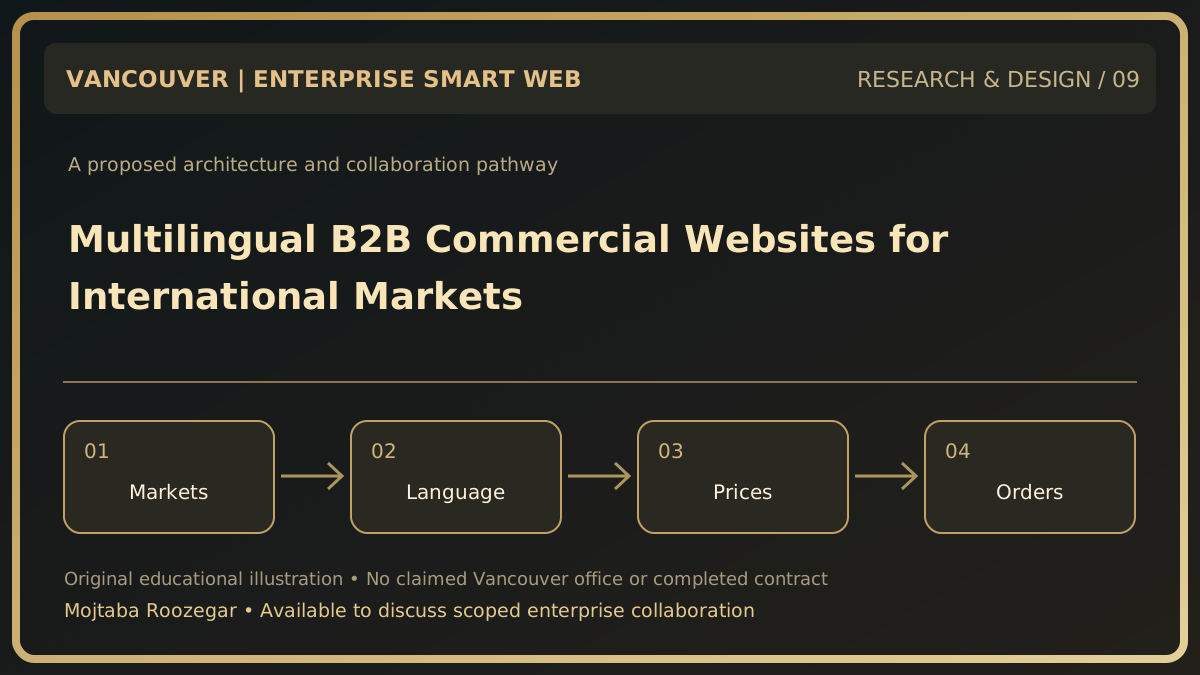
International websites need more than translation
I am open to discussing multilingual commercial websites with Vancouver companies that serve suppliers, distributors or buyers in several regions. Changing headings between English and another language is a small part of the task. Product classifications, measurement systems, commercial terms, accessibility, customer support and legal notices may vary by market. A sound architecture separates translated content from business rules that must remain precise across languages.
Establish authoritative commercial data
Keep a canonical product identifier while supporting localized names, descriptions, attributes and regulatory fields. Store financial values with explicit currencies and use carefully governed exchange-rate logic when conversion is needed. The currency shown to the customer should match the invoice and contracting terms, not a silently refreshed approximate rate. Unit conversion also requires precision: a translated measurement without its unit can cause incorrect purchasing decisions.
Respect indexing and navigation
Give each language version a stable URL and suitable internal navigation. Use correct language metadata, self-consistent canonicals and hreflang annotations when those are appropriate. Do not mechanically duplicate low-quality text across dozens of languages or treat automatic translation as legal review. Human oversight matters for warranty and safety information. Search-engine optimization should aim for accurate user intent and useful content, not artificial keyword repetition.
Protect the buying journey
A purchasing portal needs accessible forms, clear error messages, correct right-to-left layout where applicable and consistent identity across localized routes. Order terms, taxes and duties may require market-specific expertise. Do not imply that a currency display itself establishes compliant international payment acceptance. Test with realistic buyer scenarios and ensure an authenticated organization's private pricing remains protected regardless of requested language.
Collaboration proposition
A feasible pilot might localize one product family, one supplier onboarding flow and a sample invoice for two chosen markets using noncommercial data. Acceptance measures would cover terminology accuracy, navigation, authorization and responsive layout. I welcome appropriate Vancouver international commerce teams as potential collaborators, subject to mutually defined scope and local legal review.
Author: Mojtaba Roozegar. This is a professional invitation for Vancouver collaboration, with hypothetical design examples rather than verified engagements or business registrations.