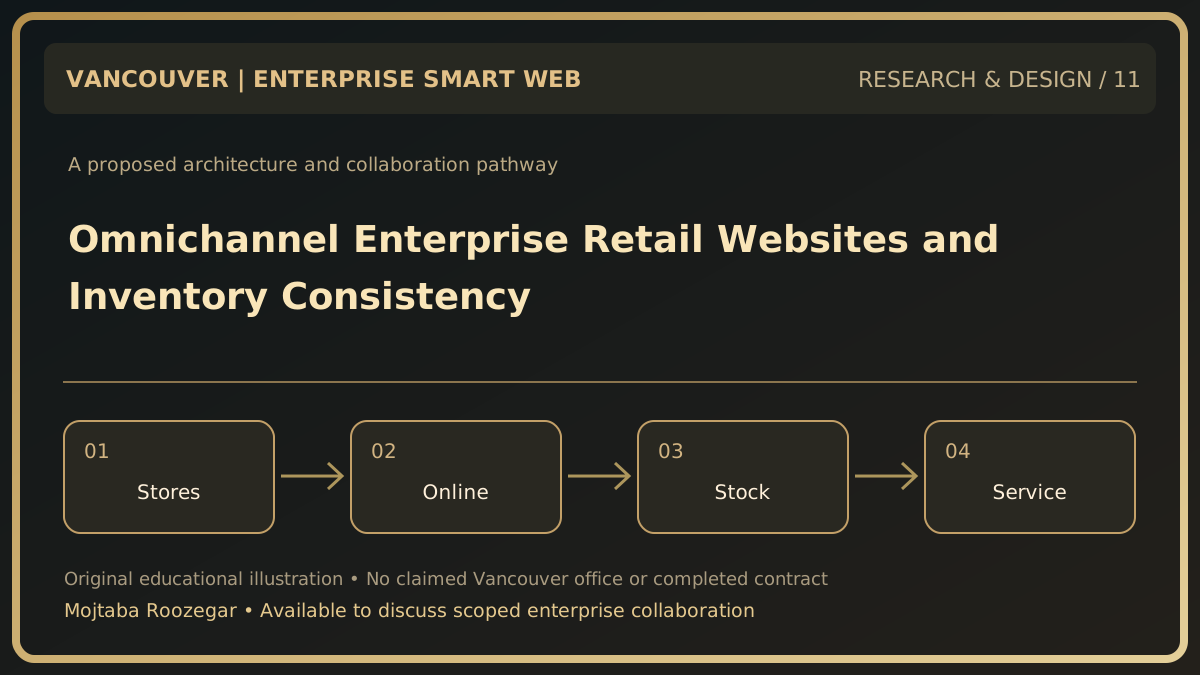
A commercial website is a distributed workflow
I am open to working with Vancouver retail and commercial technology teams on intelligent websites that bridge stores, distributors, warehouses and online customers. A beautiful storefront alone cannot guarantee a reliable customer experience when products are sold through several channels. The architecture must explain how pricing, available stock, returns and fulfillment state remain consistent.
Define a single source of commercial truth
A shared product identifier should link localized descriptions, images, variants, tax classifications and supplier metadata. Inventory needs separate on-hand, reserved and available quantities for each location. A browser displaying available stock must communicate its freshness, especially when external point-of-sale systems update asynchronously. Overselling can arise when multiple customers reserve the final item at once; enforce database constraints and an atomic reservation process instead of trusting client-side quantity checks.
Treat orders as stateful records
Cart creation, order submission, payment observation, fulfillment and refund are different events. A customer retry after a timeout should not create a duplicate paid order. Stable idempotency identifiers and authoritative transaction state help protect correctness. Shipment and pickup options need documented cutoff rules; a status message cannot be labeled confirmed until the relevant system verifies it. Administrative overrides should produce audit records and remain restricted to authorized roles.
Design useful cross-channel experiences
Customers should be able to find products, understand pickup availability, inspect delivery conditions and contact support without unnecessary friction. Store teams may need a different operational interface from online customers. Build accessible navigation and account controls, clear error recovery, mobile-first product cards and meaningful search filters. Measure conversion only after instrumentation quality and consent requirements are reviewed. External marketing scripts must not compromise secure checkout.
Pilot and collaboration invitation
A modest prototype could simulate two locations, one warehouse, three products with variants and competing reservations. Evaluate stock reconciliation, permissions, order idempotency and performance before considering production. I welcome discussion with Vancouver retailers or commerce integrators willing to define measurable acceptance criteria and a governed integration plan.
Author: Mojtaba Roozegar. Scope, lawful operating arrangements and commercial terms would be agreed with a prospective Vancouver organization; case descriptions are illustrative.